

If We’re Making Money, Why Is Cash Still Late?
Executive Summary - April 15, 2026
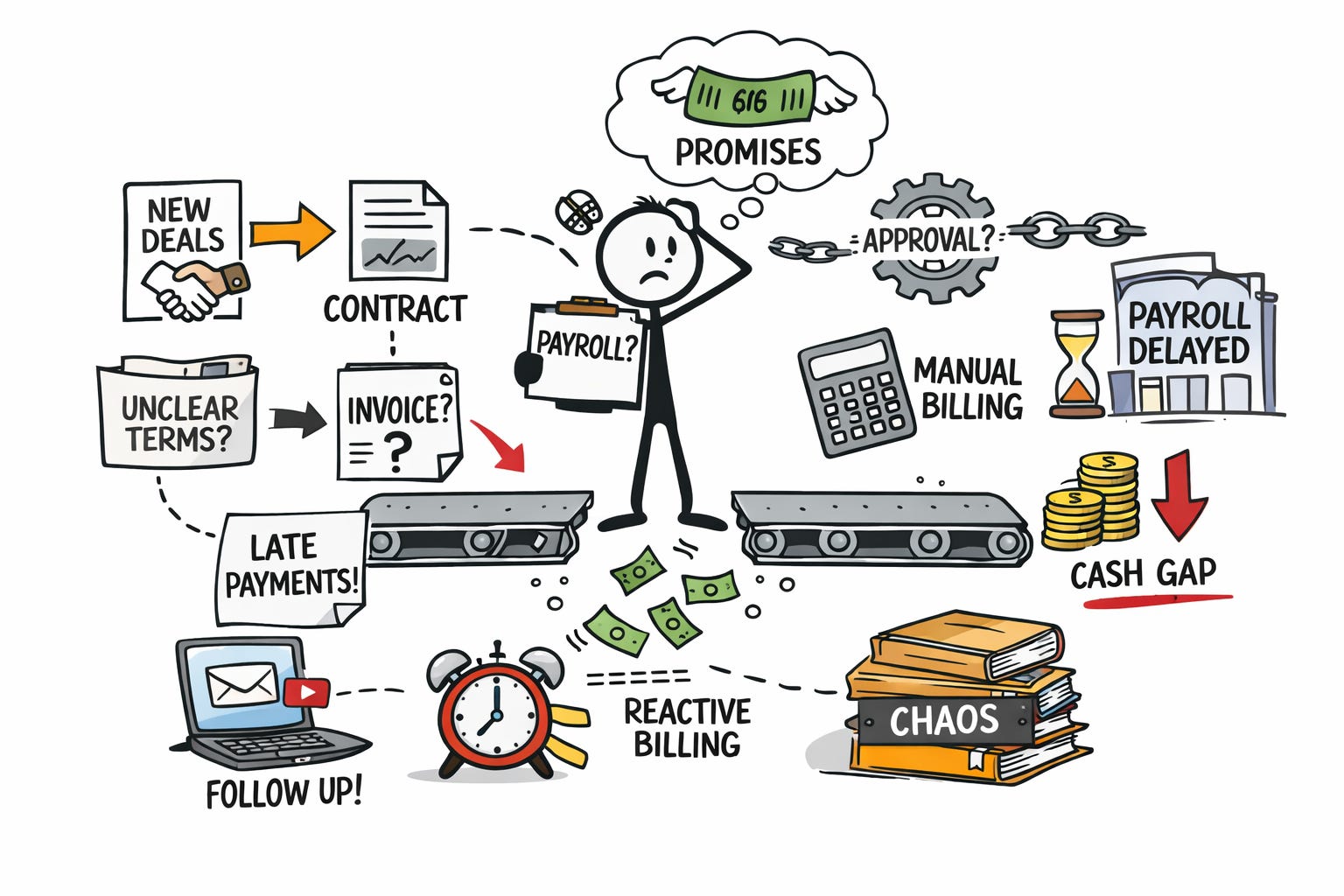
Drawing insights from a McKinsey article entitled How quote-to-cash excellence can fuel growth for B2B subscription businesses by Bibhudatta Dash and Richelle Deveau
The Pain You’re Feeling
Revenue appears strong, yet cash arrives inconsistently.
Invoices are delayed, corrected, or disputed.
Billing depends on follow-up, clarification, and memory.
Sales closes deals, but finance struggles to operationalize them.
Operations discovers delivery requirements after commitments have already been made.
Founders or senior leaders step in to reconcile what was sold, what should be billed, and what has actually been delivered.
Nothing appears fundamentally broken. The company may be growing. Yet cash conversion feels unreliable.
More deals do not translate into smoother cash flow.
More effort does not eliminate friction.
These are not isolated errors.
They are signs of a system that is not governing how revenue becomes cash.
The Misdiagnosis
The response to cash flow issues often looks like:
Pushing to increase revenue
Tracking revenue, but not how it converts to cash
Reactive billing, invoicing when cash runs low
Cost-cutting to compensate for inconsistency
These responses treat cash flow as a volume or timing problem.
They assume that more sales, tighter spending, or better follow-up will resolve the issue.
They do not address how contract data is structured, carried, and executed across the system.
The result is more effort applied to the wrong part of the system.
What Is Actually Happening
In How quote-to-cash excellence can fuel growth for B2B subscription businesses, McKinsey argues that companies underperform when quote-to-cash is treated as a series of disconnected steps rather than an integrated system.
The thesis is straightforward: cash flow depends on how well contract data is structured, standardized, and translated into operational workflows.
The article points to four drivers of performance: offering structure, order management, work complexity, and coordination needs.
When these are poorly designed:
Contract terms are inconsistent or ambiguous
Billing triggers are unclear or undocumented
Data cannot be cleanly transferred into invoicing systems
Manual intervention fills the gaps
Growth introduces variation. Variation introduces complexity.
If contract data is not structured to absorb that complexity, execution becomes dependent on people rather than systems.
Revenue is generated. But it is not operationalized.
The Hidden Costs Founders Feel First
When contract data is not structured and carried into the billing system as actionable inputs:
Time fragments. Leaders are pulled into billing clarification and reconciliation.
Decision latency increases. Invoices wait on the interpretation of contract terms.
Rework rises. Corrections, disputes, and adjustments become routine.
Cost increases. Each deal requires custom handling across teams.
Cash flow slows. Revenue exists, but is delayed in conversion.
Quite often, the founder becomes the system of last resort.
Finance depends on emails, Slack messages, and memory.
Sales and delivery operate on different interpretations of the same agreement.
The hidden assumption is that downstream teams can resolve ambiguity.
In practice, ambiguity compounds.
The business does not scale in proportion to revenue.
It scales in proportion to how clearly contract data governs execution.
What Relief Feels Like
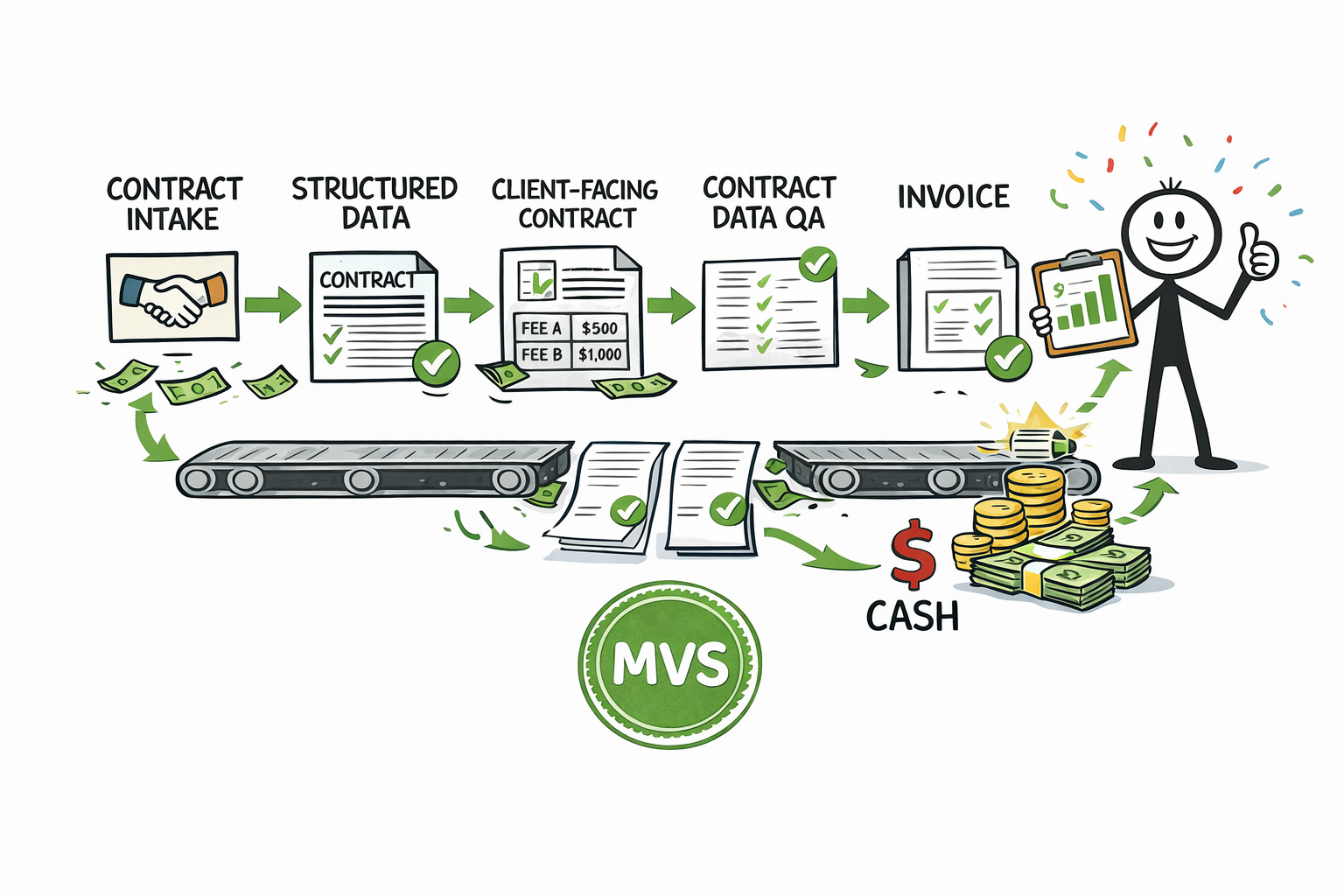
A Minimum Viable System (MVS) for cash flow is the least amount of structure required to ensure revenue consistently becomes cash.
It treats cash flow as an operational system in which contract data is intentionally structured, governs billing decisions, is validated before execution, and flows through invoicing to cash without reliance on memory or reinterpretation.
When the cash flow execution bottleneck is relieved:
Contract data is structured at intake, not reconstructed later
Billing triggers are explicit and tied to delivery or time
Roles own specific parts of the process, not just outcomes
QA occurs before invoices are generated
Data flows cleanly from contract to billing
Fewer transactions require manual intervention.
Invoices reflect the contract without reinterpretation.
Cash conversion becomes more predictable.
The founder or conscientious leader is no longer the reconciliation layer.
Time shifts from resolving discrepancies to shaping growth.
Outputs begin to match inputs.
Not because more effort was applied.
Because the system now governs how revenue becomes cash.
If this pattern feels familiar, the next step is identifying where work still depends on someone’s intervention instead of a system.
This month’s free tool is my Never Miss an Invoice System, created to solve a problem I’ve seen again and again: work gets done, but the invoice never gets sent. This system makes sure that doesn’t happen.